
Successful container cafe delivery depends on what happens before the delivery truck leaves the yard.
The buyer must select the final position, confirm that the property can legally support the café, prepare firm and level ground, measure the delivery route, remove obstacles, identify utility locations and communicate the required container orientation.
The driver cannot safely improvise around narrow entrances, low power lines, soft ground, unfinished foundations or unclear placement instructions.
To prepare your property, you should:
- Confirm zoning and placement approval.
- Select the exact final location.
- Mark the serving-hatch and door orientation.
- Choose the appropriate delivery method.
- Measure the complete truck route.
- Identify overhead and underground hazards.
- Prepare the foundation or supporting surface.
- Coordinate utility-entry points.
- Send site photographs and measurements.
- Keep the unloading area clear on delivery day.
This guide explains each step so you can reduce delays, additional offloading costs and the risk of a failed delivery.
Table of Contents
- Confirm property approval
- Choose the final position
- Mark the container orientation
- Select the delivery method
- Measure the delivery route
- Identify overhead and underground hazards
- Prepare firm and level ground
- Choose the foundation
- Coordinate utilities
- Prepare the customer area
- Send site photos and measurements
- Prepare for delivery day
- Inspect the café after placement
- Avoid common delivery mistakes
- Use the delivery checklist
1. Confirm That the Property Can Be Used for a Container Cafe
Before preparing the ground, confirm that the proposed property can legally support a container café and food-service business.
Depending on the location and intended use, you may need:
- Property-owner approval
- Zoning approval
- Land-use approval
- Building or placement permit
- Food-establishment approval
- Electrical permit
- Plumbing permit
- Fire inspection
- Sign permit
- Certificate of occupancy
- Accessible customer route
- Setback compliance
- Parking approval
A container supplier approving the delivery route does not replace the approvals required by your city, county, health authority or property owner.
Contact the departments responsible for:
- Planning and zoning
- Building permits
- Food-service regulation
- Fire safety
- Water and sewer
- Electrical service
- Property access
Ask whether there are restrictions concerning:
- Distance from property lines
- Distance from other structures
- Customer parking
- Fire-department access
- Outdoor seating
- Signs
- Utility connections
- Drainage
- Permanent or temporary placement
Do not wait until the café is in transit before checking these requirements.
Local feedback may affect where the café can be placed, which side faces customers, how the foundation is constructed and where utilities enter the unit.
2. Choose the Exact Final Position
The final café position should be selected before delivery is scheduled.
Do not simply identify a general area of the property. Mark the precise footprint where the container will remain.
The position should account for:
- Serving-hatch direction
- Customer approach
- Personnel-door access
- Ordering line
- Customer pickup
- Outdoor seating
- Parking
- Food-supplier deliveries
- Waste collection
- Utility connections
- Fire access
- Sun exposure
- Shade
- Rain runoff
- Drainage
- Future expansion
- Equipment maintenance access
The serving hatch should face the intended customer-service area.
Avoid positioning it toward:
- A fence
- A neighboring property
- A service alley
- A drainage ditch
- An inaccessible side of the site
- A location with no customer walkway
The personnel door should remain accessible to employees and should not open into a customer queue, fence, utility post or storage area.
Also think about the final customer experience.
Customers should be able to:
- See the café
- Approach safely
- Read the menu
- Form a line
- Place an order
- Wait without blocking access
- Collect the order
- Leave the area easily
Use stakes, paint, flags, cones or chalk to mark all four corners of the intended container position.
The markings should also identify:
- Serving-hatch side
- Personnel-door side
- Container-door end
- Customer-facing direction
- Utility-entry side
3. Confirm the Container Orientation Before Delivery
Container orientation is just as important as the placement location.
Before the truck arrives, the carrier should know:
- Which direction the container doors must face
- Which side contains the serving hatch
- Where the personnel door must open
- Which side faces customers
- Where utility connections will enter
- Whether the café must align with a walkway or patio
This information is particularly important for tilt-bed delivery.
The container normally slides from the rear of the delivery truck. The truck must therefore approach from the correct direction to leave the café facing the way you intended.
Repositioning the café after unloading may require:
- Crane
- Heavy-capacity forklift
- Container-moving equipment
- Second transport visit
- Additional labor
Create a basic site diagram showing:
- Street entrance
- Truck route
- Proposed truck position
- Container footprint
- Container-door direction
- Serving-hatch direction
- Personnel-door location
- Customer area
- Utility points
- Nearby structures
Send this diagram to the delivery provider before confirming the appointment.
A simple marked drawing can prevent an expensive orientation mistake.
4. Select the Correct Delivery and Offloading Method
The delivery method depends on the property, available space, ground conditions and required final placement.
The three common options are tilt-bed, flatbed and crane-assisted delivery.
Tilt-Bed Delivery
A tilt-bed truck transports the container and unloads it by raising the bed and allowing the container to slide onto the prepared surface.
Tilt-bed delivery may be suitable when:
- The truck can back toward the final position
- There is enough straight unloading space
- The ground can support the truck
- The placement area is directly accessible
- There are no low overhead obstacles
- The site is not excessively sloped
- Precise side-to-side placement is not difficult
Advantages
- The delivery vehicle performs the offload
- A separate crane may not be required
- It can be practical for open commercial and residential sites
- It may reduce the number of contractors involved
Limitations
- It requires substantial straight-line access
- The truck must usually back toward the final position
- Side-to-side placement may be limited
- Soft ground can prevent safe access
- Tight properties may not provide enough unloading room
- Orientation must be planned carefully
Flatbed Delivery
A flatbed carries the container to the property but generally does not unload it by itself.
The customer may need to arrange:
- Crane
- Heavy forklift
- Reach stacker
- Other suitable lifting equipment
A flatbed may work when the customer or site already has suitable offloading equipment.
Before selecting this method, confirm:
- Who is responsible for unloading
- Lifting capacity
- Operator availability
- Equipment arrival time
- Safe lifting points
- Final placement method
- Waiting-time charges
Do not assume that a standard warehouse forklift can safely lift a fully converted 20ft café.
The lifting equipment must be rated for the unit’s actual weight and dimensions.
Crane-Assisted Delivery
A crane may be needed when the café must be placed:
- Over a fence
- Beyond the truck’s immediate reach
- Between existing buildings
- On prepared supports
- In a location without straight tilt-bed access
- At a different elevation
- Within a restricted commercial site
Crane placement may provide greater control, but it requires additional planning.
Important considerations include:
- Crane reach
- Outrigger space
- Ground-bearing capacity
- Underground utilities
- Overhead wires
- Nearby buildings
- Lift path
- Wind conditions
- Road access
- Safe working area
- Equipment time
The crane operator may need to inspect the property before delivery.
Clad Containers should review your delivery address, site photographs, measurements, final placement and known obstacles before recommending a delivery method.
5. Measure the Complete Delivery Route
Measure the route from the public road to the café’s final position.
Do not measure only the container footprint.
The truck and offloading equipment require significantly more space than the container itself.
Record:
- Street width
- Entrance width
- Gate width
- Driveway width
- Tightest turn
- Turning area
- Straight unloading distance
- Overhead clearance
- Surface type
- Slope
- Distance from the truck position to the foundation
Inspect the route for:
- Parked vehicles
- Mailboxes
- Fences
- Gate posts
- Retaining walls
- Trees
- Low branches
- Utility poles
- Roof overhangs
- Canopies
- Drainage ditches
- Soft shoulders
- Narrow bridges
- Culverts
- Septic systems
Some tilt-bed carriers may require planning dimensions in the general range of 12 to 14 feet of access width, 14 to 16 feet of overhead clearance and approximately 80 to 100 feet of straight unloading space for a 20ft container.
These figures are examples only.
The exact requirements depend on:
- Truck type
- Trailer design
- Container
- Driver
- Property
- Delivery direction
- Ground conditions
Always obtain the final access requirements from the carrier assigned to your delivery.
6. Check Overhead and Underground Obstacles
Both overhead and underground hazards can prevent delivery or create serious safety risks.
Overhead Obstacles
Check for:
- Electrical power lines
- Communication cables
- Tree branches
- Building overhangs
- Signs
- Carports
- Canopies
- Exterior lights
- Bridges
- Covered entrances
Remember that the container sits on top of the trailer during transportation.
The combined truck, trailer and container height is greater than the café height when placed on the ground.
The delivery route must therefore have enough clearance for the complete loaded vehicle.
Underground Obstacles
Identify:
- Septic tanks
- Drain fields
- Water lines
- Gas lines
- Irrigation systems
- Electrical cables
- Drainage pipes
- Underground tanks
- Weak culverts
- Recently filled trenches
Heavy trucks and crane outriggers should not be positioned over underground infrastructure that may collapse.
Before excavation, trenching or foundation work, contact the appropriate utility-location service for your area.
Mark all known underground services on the site diagram provided to the carrier and crane operator.
7. Prepare Firm and Level Ground
The final placement area should be firm, level, drained and free of debris.
Placing the café on an uneven or unstable surface can cause:
- Container twisting
- Misaligned doors
- Difficult personnel-door operation
- Serving-hatch problems
- Sloping counters
- Uneven appliances
- Water pooling
- Structural stress
- Drainage issues
Possible placement surfaces include:
- Compacted gravel
- Concrete pad
- Concrete piers
- Engineered footings
- Properly selected foundation blocks
The correct solution depends on:
- Soil type
- Site slope
- Drainage
- Local regulations
- Planned permanence
- Utility design
- Environmental conditions
- Container use
Loose soil, wet grass, mud and uncompacted fill may not support the delivery vehicle or café.
If the truck must drive across grass or unpaved ground, discuss the conditions with the carrier before scheduling.
Recent rain may make an otherwise suitable property unsafe for delivery.
Do not use random bricks, scrap wood or unstable materials as permanent supports.
Ask a qualified contractor or engineer to recommend the correct support method for the property.
8. Plan the Foundation Around the Cafe Use
A container café has different support requirements from an empty temporary storage container.
The finished unit may eventually contain:
- Espresso machines
- Refrigerators
- Freezers
- Counters
- Sinks
- Water tanks
- Plumbing
- Employees
- Inventory
- HVAC equipment
- Exterior awning
- Customer-service counter
The foundation should support the completed operation, not only the empty shell.
Compacted Gravel
A compacted-gravel base may be suitable when:
- Soil conditions are appropriate
- Drainage is controlled
- Local requirements allow it
- The area is properly leveled and compacted
Gravel can provide drainage and may be less extensive than a full concrete slab.
Concrete Pads or Piers
Concrete pads or piers may support the container at key structural locations.
They may allow:
- Airflow beneath the unit
- Utility access
- Reduced concrete use
- Level adjustment
Their size, depth and spacing should be determined by site conditions and applicable requirements.
Full Concrete Slab
A full slab may be considered for:
- Permanent commercial installations
- Integrated patios
- Heavier fit-outs
- Sites requiring a continuous surface
- Local building requirements
A slab may also simplify customer walkways and exterior improvements, but it generally requires more preparation and cost.
Engineered Foundation
Professional design may be needed for:
- Weak soil
- Sloped sites
- Flood-prone properties
- High-wind areas
- Seismic requirements
- Extensive structural modifications
- Elevated placement
- Local commercial-building approval
There is no single foundation that is correct for every container café.
Confirm the final support system with the local building authority, qualified contractor or engineer.
9. Coordinate Utilities Before the Container Arrives
Utility planning should begin before the café is delivered, but final connections are normally completed after placement.
Potential utilities include:
- Electrical service
- Potable water
- Sewer
- Wastewater system
- Fresh-water tank
- Internet
- HVAC power
- Exterior lighting
- Security system
- Drainage
The site plan should identify:
- Electrical entry point
- Water entry
- Wastewater exit
- HVAC location
- Water-heater position
- Exterior shutoffs
- Trench routes
- Equipment clearances
A practical sequence is:
- Confirm the final café position.
- Confirm where utilities will enter the unit.
- Prepare required trenches or connection points.
- Keep the truck route and placement footprint clear.
- Deliver and position the container.
- Complete final utility connections.
- Test all services.
Avoid installing utility posts, pipes or equipment where they will obstruct:
- Delivery truck
- Crane
- Outriggers
- Tilt-bed path
- Container footprint
- Personnel door
- Serving hatch
Open utility trenches may also prevent delivery vehicles from reaching the placement area.
Coordinate the site contractor, electrician, plumber and delivery provider before beginning major utility work.
10. Prepare the Customer Area Without Blocking Delivery
A completed container café site may eventually include:
- Outdoor seating
- Decking
- Canopy
- Menu board
- Accessible walkway
- Exterior counter
- Planters
- Queue barriers
- Waste station
- Exterior lighting
- Landscaping
However, permanent customer improvements should not block the delivery route.
The preferred sequence is usually:
- Complete required site and foundation preparation.
- Keep the delivery route open.
- Deliver and position the café.
- Inspect the placement.
- Complete utility connections.
- Build customer-facing improvements.
Installing decking, fences, planters or seating too early can make it impossible for the truck or crane to reach the foundation.
Some accessibility or foundation work may need to be completed first, but the carrier should review the plan before construction begins.
11. Send Site Photos and Measurements Before Scheduling
Clear site photographs allow the delivery team to identify problems before dispatch.
Send photographs of:
- Street entrance
- Driveway
- Gate
- Narrow sections
- Tight turns
- Low branches
- Power lines
- Final placement area
- Ground surface
- Nearby buildings
- Fences
- Utility poles
- Foundation markings
- Container orientation markings
Photograph the route in both directions.
A short video walking from the public road to the placement point can also be helpful.
Provide:
- Full delivery address
- ZIP code
- Onsite contact
- Phone number
- Gate code
- Access restrictions
- Route measurements
- Ground description
- Preferred placement
- Serving-hatch direction
- Personnel-door direction
- Container-door direction
- Known overhead hazards
- Known underground services
- Preferred delivery date
- Expected delivery method
Do not hide access concerns because you are worried the carrier may refuse the delivery.
It is better to identify a problem early and select the correct equipment than to send a truck that cannot reach the site.
12. Keep the Property Clear on Delivery Day
Before the delivery truck arrives:
- Remove vehicles from the route
- Unlock gates
- Move trailers
- Move machinery
- Remove temporary fences
- Trim approved branches
- Clear loose materials
- Remove waste
- Close open trenches or protect them appropriately
- Keep workers outside the unloading zone
- Keep children and pets indoors
- Confirm foundation markings
- Confirm container orientation
- Make sure the onsite decision-maker is present
- Keep your phone available
The person onsite should understand:
- Final position
- Serving-hatch direction
- Personnel-door direction
- Container-door direction
- Utility-entry points
- Approved delivery route
- Customer-facing side
Delivery personnel should not have to call several people to determine where the café should be placed.
Only the driver, crane operator or designated delivery crew should direct the offloading process.
Keep bystanders away from:
- Truck
- Trailer
- Container
- Crane
- Outriggers
- Lift path
- Unloading area
13. Inspect the Cafe After Placement
After the café has been positioned, inspect the unit before the delivery equipment leaves whenever it is safe and practical.
Check:
- Container level
- Final orientation
- Foundation contact
- Container doors
- Personnel door
- Serving hatch
- Locks
- Exterior condition
- Interior condition
- Floor
- Wall finish
- Ceiling
- Electrical fixtures
- Ventilation
- Windows and seals where applicable
Open and close every door and hatch.
A container that is not level may have doors that bind or fail to close properly.
Take photographs of:
- All four exterior sides
- Roof where visible
- Interior
- Floor
- Serving hatch
- Personnel door
- Container doors
- Foundation contact points
Record any concerns before electricians, plumbers, contractors or equipment installers begin further work.
Do not attempt to push or drag the café using a vehicle, small forklift or unsuitable equipment.
Any repositioning should be completed using properly rated container-handling equipment.
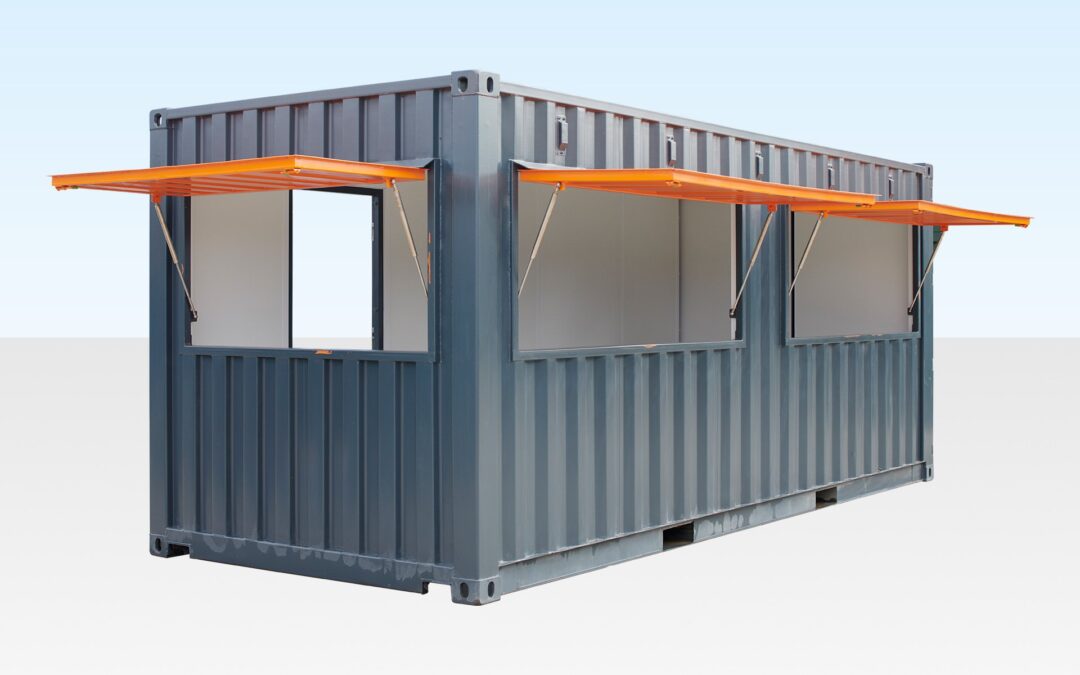
Preparing for Delivery of the Clad Containers 20ft Cafe
Clad Containers offers a 20ft shipping container café for sale with:
- Serving hatch
- Personnel access door
- Electrical installation
- Insulation
- Finished interior
- Secure steel construction
The unit is sold as a ready-to-fit café shell. Buyers can add their selected counters, sinks, appliances, refrigeration, plumbing, HVAC, branding and other business-specific equipment.
Nationwide delivery and crane-offloading options are available, subject to destination and site conditions.
Before requesting a delivery quotation, provide:
- Delivery ZIP code
- Complete address
- Property photographs
- Access measurements
- Ground description
- Proposed foundation
- Placement markings
- Hatch and door orientation
- Overhead hazards
- Underground hazards
- Preferred offloading method
This information helps Clad Containers and the carrier determine whether tilt-bed, flatbed or crane delivery is appropriate.
Container Cafe Delivery Mistakes to Avoid
Choosing the Site After Ordering
The final location should be evaluated before the café is dispatched.
Measuring Only the Container Footprint
The truck and offloading equipment require much more space than the café itself.
Ignoring the Truck’s Turning Route
A large placement area is not useful when the delivery vehicle cannot enter or turn.
Forgetting Overhead Clearance
Low wires, tree branches and building overhangs can prevent access.
Preparing Soft or Uneven Ground
The delivery vehicle may become stuck, or the café may sit incorrectly.
Failing to Mark the Orientation
The serving hatch or personnel door may face the wrong direction.
Installing Decking Too Early
Decking, seating, fences and landscaping can block the offloading area.
Leaving Utility Trenches Open
Open trenches can prevent a truck or crane from reaching the placement point.
Assuming the Driver Can Reposition the Cafe
A tilt-bed may place the container only in the direction allowed by the truck approach. Later repositioning may require additional lifting equipment.
Not Providing Accurate Site Photos
Incomplete photographs can hide hazards that become obvious only after the truck arrives.
Not Being Present
A knowledgeable onsite representative should confirm the final position and orientation.
Scheduling During Poor Ground Conditions
Recent rain, snow or construction activity may make the delivery route unsafe.
Container Cafe Delivery Checklist
Before Ordering
- Confirm zoning and land use.
- Obtain property-owner approval.
- Choose the final café location.
- Decide which side faces customers.
- Identify utility-entry points.
- Review foundation options.
- Confirm that the property can receive a delivery vehicle.
- Consider future seating and expansion.
Before Scheduling Delivery
- Send the complete address and ZIP code.
- Send street, driveway and site photographs.
- Measure the gate and driveway.
- Measure turns and overhead clearances.
- Identify overhead utilities.
- Identify underground utilities.
- Confirm the foundation is prepared.
- Mark all four corners.
- Mark the serving-hatch direction.
- Mark the personnel-door direction.
- Confirm tilt-bed, flatbed or crane delivery.
- Confirm who is responsible for offloading.
- Keep the delivery route open.
Before the Truck Arrives
- Remove parked vehicles.
- Unlock gates.
- Move equipment and trailers.
- Remove temporary barriers.
- Clear approved branches.
- Secure pets.
- Keep children and workers away.
- Confirm the onsite representative.
- Review the site diagram.
- Check the ground after recent weather.
- Confirm the driver has the correct phone number.
After Placement
- Check that the café is level.
- Confirm orientation.
- Open and close all doors.
- Open and close the serving hatch.
- Inspect the exterior.
- Inspect the interior.
- Photograph the unit.
- Confirm foundation contact.
- Report immediate concerns.
- Complete final utility connections.
- Begin customer-area construction.
Prepare the Property Before the Truck Is Dispatched
A smooth container cafe delivery depends more on preparation than improvisation.
Before scheduling, confirm:
- Legal property use
- Final placement
- Delivery route
- Offloading method
- Ground conditions
- Foundation
- Orientation
- Utility locations
- Site access
- Onsite contact
Clad Containers can help determine the appropriate delivery arrangement after reviewing your ZIP code, address, photographs, measurements and placement requirements.
Review the 20ft container cafe and contact Clad Containers to request current availability, delivery pricing and offloading options for your property.
Frequently Asked Questions
How much space is needed for a 20ft container delivery?
The exact space depends on the delivery truck and offloading method. Tilt-bed carriers may require substantial straight-line access in addition to adequate gate width and overhead clearance. Ask the assigned carrier to confirm the exact requirements for your property.
Can a container cafe be delivered with a tilt-bed truck?
Yes, when the truck can back toward the prepared placement area and there is enough straight, firm and unobstructed access. Tight sites or locations beyond the truck’s reach may require crane delivery.
When is a crane required for container delivery?
A crane may be required when the café must be placed over a fence, beyond the truck’s immediate position, between structures or on a site without suitable tilt-bed access.
Does the ground need to be level before delivery?
Yes. The final placement area should be firm and level so the café sits correctly and its doors and serving hatch operate properly.
What foundation does a container cafe need?
The correct foundation depends on soil, drainage, local regulations and intended use. Options may include compacted gravel, concrete pads, piers, a slab or an engineered foundation.
Can a container be delivered over a fence?
Potentially, but this normally requires a crane with adequate reach and a safe lift path. The crane operator must review the site, ground conditions, utilities and surrounding structures.
Can the driver reposition the cafe after unloading?
Not always. Tilt-bed placement may provide limited repositioning ability. Moving the café later may require a crane, heavy forklift or specialized container-moving equipment.
Should utilities be installed before delivery?
Plan utility locations before delivery, but avoid placing pipes, posts or open trenches where they block the truck, crane or container footprint. Final connections are usually completed after placement.
What site photos should I send before scheduling?
Send photographs of the street entrance, driveway, gate, turns, overhead obstacles, final placement area, surface, nearby structures, utility lines and foundation markings.
Does Clad Containers include offloading?
Offloading arrangements depend on the written delivery quotation and selected delivery method. Confirm whether tilt-bed or crane offloading is included before completing the order.
What happens if the truck cannot access my property?
The delivery may be delayed, rescheduled or require different equipment. Additional transportation, crane or waiting charges may apply depending on the circumstances and quotation.
Do I need to be present during delivery?
A knowledgeable adult representative should normally be present to confirm the final position, orientation and access route unless another arrangement has been approved in writing.