
Choosing between a container cafe vs food truck comes down to one central question:
Do you want customers to travel to your business, or do you want your business to travel to customers?
A container café is generally better for entrepreneurs who have access to a strong fixed location and want more workspace, permanent branding, outdoor seating and fewer vehicle-related maintenance concerns.
A food truck is generally better for businesses that need regular mobility, event access, private catering opportunities and the ability to test several sales locations.
Neither model is automatically cheaper, easier to operate or more profitable. A food truck may reduce permanent site-development costs, but it introduces fuel, commercial vehicle insurance, mechanical maintenance, parking and daily transportation responsibilities.
A container café removes the engine and drivetrain from the business model, but it requires a suitable property, delivery, offloading, site preparation, utility planning and local placement approvals.
The right option depends on your menu, location strategy, equipment, staffing, available capital and long-term growth plan.
Table of Contents
- Container cafe vs food truck comparison
- What is a container café?
- What is a food truck?
- Mobility and location strategy
- Interior workspace
- Menu and equipment capacity
- Startup costs
- Ongoing operating costs
- Maintenance and breakdown risks
- Permits and compliance
- Utilities and daily operations
- Branding and customer loyalty
- Staffing
- Weather and seasonal operations
- Growth and expansion
- Business-model recommendations
- Decision checklist
Container Cafe vs Food Truck at a Glance
| Factor | Container café | Food truck |
|---|---|---|
| Mobility | Relocatable, but not routinely mobile | Designed for regular travel |
| Best location model | Fixed or semi-permanent site | Multiple locations and events |
| Interior workspace | Usually more usable space | Compact vehicle-based layout |
| Equipment flexibility | Greater customization potential | Limited by space and vehicle weight |
| Vehicle maintenance | None | Engine, tires, brakes and drivetrain |
| Site preparation | Usually required | Usually limited at each stop |
| Utility options | Permanent or tank-based | Generator, batteries, propane or tanks |
| Branding presence | Strong permanent destination | Moving advertisement |
| Customer seating | Easy to add outside | Depends on each location |
| Daily transportation | Not required | Required |
| Mechanical breakdown risk | Low | Can stop the entire business |
| Event flexibility | Possible with planned relocation | Strong |
| Fixed-location visibility | Strong | Depends on schedule and parking |
| Expansion model | Add containers or another location | Add trucks or trailers |
| Resale factors | Container condition and fit-out | Vehicle age and mechanical condition |
The right model depends on how the business will attract and serve customers.
Choose a container café when location consistency is central to the plan.
Choose a food truck when regular movement is essential to reaching customers.
What Is a Container Cafe?
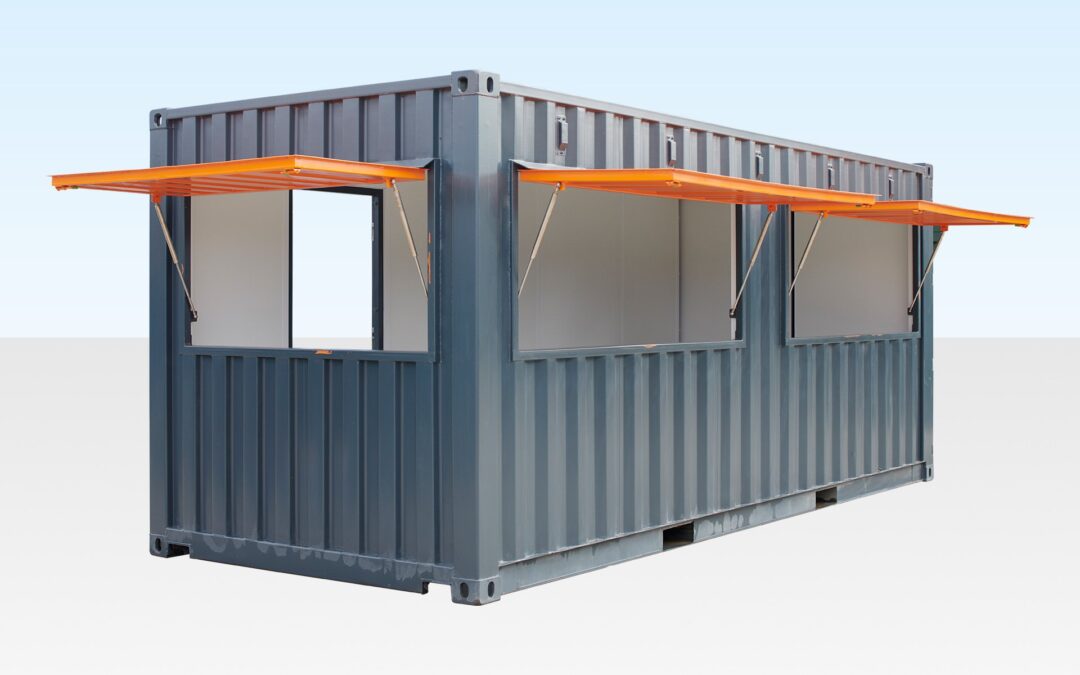
A container café is a shipping container that has been structurally modified to support a food, beverage or hospitality business.
Common uses include:
- Coffee shop
- Smoothie bar
- Dessert kiosk
- Bakery outlet
- Concession stand
- Grab-and-go café
- Campus coffee shop
- Resort refreshment unit
- Brewery food-service point
- Construction-site canteen
A container café is normally delivered to a prepared site and remains there for an extended period.
It can be relocated, but relocation is usually a planned project rather than part of daily operations. The café may need to be disconnected from utilities, emptied or secured, loaded onto suitable transport and delivered to another approved site.
A container café is therefore better described as relocatable than mobile.
Businesses that prefer a stable location can begin with this 20ft shipping container café for sale.
The Clad Containers unit includes a serving hatch, personnel access door, electrical installation, insulation and a finished interior. It is sold as a ready-to-fit café shell, allowing the buyer to select and install the counters, sinks, appliances, refrigeration, plumbing and branding required for the business.
What Is a Food Truck?
A food truck combines a commercial food or beverage workspace with a road-going vehicle.
Depending on its design, a food truck may include:
- Cooking appliances
- Coffee equipment
- Refrigeration
- Sinks
- Fresh-water tank
- Wastewater tank
- Generator or battery system
- Propane equipment
- Serving window
- Storage
- Point-of-sale equipment
Food trucks commonly operate at:
- Festivals
- Markets
- Office districts
- Breweries
- College campuses
- Private events
- Corporate catering jobs
- Approved street-vending locations
- Seasonal attractions
The main advantage is mobility. A truck can travel to different customer groups instead of relying entirely on one fixed property.
However, the business must manage both the food-service operation and the vehicle.
A functioning kitchen is not enough. The truck must also remain registered, insured, mechanically reliable and legally permitted to travel and operate at each location.
Which Model Offers Better Mobility?
A food truck is the stronger choice when movement is part of the sales strategy.
Food truck mobility advantages
A truck may allow the business to:
- Attend festivals
- Serve private events
- Visit office districts
- Follow seasonal demand
- Test different neighborhoods
- Provide corporate catering
- Move when one location performs poorly
- Reach customers without waiting for them to visit a fixed site
This flexibility is valuable for businesses whose customers are spread across several areas.
Food truck mobility limitations
Regular movement also introduces:
- Fuel costs
- Driving time
- Route planning
- Parking restrictions
- Vehicle wear
- Mechanical breakdowns
- Event travel
- Daily setup and closing procedures
- Location-specific permits
A business may spend significant time moving, parking and preparing the vehicle instead of serving customers.
Container cafe mobility
A container café can be relocated, but it is not intended to move every morning.
Relocation may require:
- Disconnecting utilities
- Securing equipment
- Crane or tilt-bed handling
- Professional transportation
- A prepared destination
- New site approval
A container café is better when the location itself is part of the business.
Choose a food truck when the business needs to move.
Choose a container café when the business needs to become a destination.
Which Model Is Better for a Fixed Location?
A container café can be particularly effective when placed at a property with predictable traffic.
Suitable locations may include:
- Business parks
- College campuses
- Construction sites
- Resorts
- Campgrounds
- Marinas
- Breweries
- Wineries
- Sports facilities
- Retail centers
- Tourist destinations
- Private commercial land
A stable site can help the business build repeat customer habits.
Customers know:
- Where the café is located
- When it opens
- Where to park
- Where to order
- Where outdoor seating is available
- How to find it again
A fixed location may also support:
- Permanent utility connections
- Outdoor seating
- Landscaping
- Covered ordering areas
- Permanent signs
- Exterior lighting
- Waste collection
- Regular deliveries
- Consistent online map listings
A food truck can remain at one regular location, but the owner should consider whether paying for a mobile vehicle makes sense when the business rarely moves.
If the main plan is to remain parked on the same property, a container café may provide more usable workspace without the vehicle-related systems.
Which Model Provides More Working Space?
A 20ft container café generally provides a simple rectangular interior.
It does not need to work around:
- Driver’s cab
- Steering controls
- Engine compartment
- Wheel wells
- Vehicle doors
- Road-weight distribution
This can make it easier to install:
- Full-length counters
- Wall-mounted shelving
- Undercounter refrigerators
- Sinks
- Dry storage
- Equipment stations
- Employee walkways
A food truck must divide its available structure between the vehicle and the food-service operation.
Equipment placement may also be influenced by vehicle weight and balance.
However, neither option provides unlimited room. Both require a carefully planned workflow.
A poor container layout can become just as crowded as a food truck when the business installs too many appliances or offers an overly complicated menu.
For practical layout concepts, review our guide to 20ft container cafe layout ideas.
Which Business Supports a Larger Menu?
A container café may provide more flexibility for businesses that need separate food and beverage stations.
It may be better suited to:
- Espresso and brewed coffee
- Smoothies
- Pastries
- Desserts
- Cold food
- Sandwich preparation
- Larger refrigeration
- Display cases
- Additional sinks
- More dry storage
A food truck can also support a successful menu, but focused offerings often work best.
Food trucks are especially effective for:
- Signature dishes
- Limited menus
- Fast production
- Event-friendly food
- Products that can be prepared consistently in a compact workspace
A broad menu is not automatically more profitable.
Every additional item may require:
- More ingredients
- More storage
- Additional equipment
- Extra training
- Longer preparation times
- More cleaning
- Increased food waste
The best business model is the one that supports a menu employees can prepare quickly and consistently within the available space.
Equipment and Weight Considerations
Both container cafés and food trucks require careful equipment planning.
Important factors include:
- Appliance dimensions
- Electrical demand
- Water supply
- Wastewater disposal
- Ventilation
- Fire protection
- Cleaning access
- Employee movement
- Service clearances
A food truck must also consider:
- Vehicle payload
- Weight distribution
- Equipment restraints
- Road movement
- Vibration
- Fuel or propane storage
- Height and width restrictions
Heavy equipment must be positioned and secured so that the vehicle remains safe to drive.
A container café does not travel daily, so its equipment does not need to support frequent road movement in the same way.
However, the container foundation, electrical system, plumbing and utility connections must be designed for the installed equipment.
Before purchasing appliances for either model, create a complete equipment schedule.
Include:
- Dimensions
- Weight
- Voltage
- Amperage
- Water connection
- Drainage
- Ventilation
- Maintenance clearance
For a more detailed checklist, read What Equipment Do You Need for a 20ft Container Cafe?.
Container Cafe vs Food Truck Startup Costs
Neither model is always cheaper.
The total startup cost depends on whether you purchase new or used equipment, how extensive the conversion is, where the business operates and which permits are required.
Container café startup costs
A container café budget may include:
- Converted container shell
- Delivery
- Crane or tilt-bed offloading
- Site preparation
- Foundation or supports
- Utility connections
- Permits
- Professional plans
- Counters
- Cabinets
- Sinks
- Plumbing
- Electrical upgrades
- Appliances
- Refrigeration
- HVAC
- Ventilation
- Exterior branding
- Outdoor customer area
- Opening inventory
Food truck startup costs
A food truck budget may include:
- Truck or trailer
- Mechanical inspection
- Kitchen conversion
- Vehicle registration
- Commercial auto insurance
- Health inspection
- Fire inspection
- Generator or battery system
- Propane system
- Fresh-water tank
- Wastewater tank
- Appliances
- Refrigeration
- Exterior wrap
- Serving window
- Storage
- Parking location
- Commissary setup where required
- Opening inventory
Do not compare only the advertised price of a truck with the price of a container shell.
Compare the complete amount required to legally open and operate each business.
A low-priced used food truck may require substantial mechanical work. A low-priced unmodified container may require structural work, insulation, electrical installation and service windows.
For a detailed breakdown of the container option, read our shipping container cafe cost guide.
Which Model Has Lower Ongoing Costs?
The monthly operating expenses are different for each business.
Container café recurring costs
A container café may need to pay for:
- Site lease
- Electricity
- Water
- Wastewater
- Insurance
- Waste collection
- Pest control
- Equipment maintenance
- Property-related fees
- Internet
- Security
- HVAC servicing
Food truck recurring costs
A food truck may need to pay for:
- Fuel
- Commercial auto insurance
- Vehicle registration
- Mechanical maintenance
- Tires
- Brakes
- Generator fuel
- Propane
- Parking
- Secure overnight storage
- Commissary charges
- Mobile vending permits
- Event fees
- Equipment maintenance
- Internet
- Cleaning
A food truck contains two operating systems:
- The food-service workspace
- The vehicle
Either system can interrupt the business.
A container café avoids engine, transmission, tire and road-related expenses, but may have higher fixed-site costs.
The better option depends on whether the business model benefits enough from mobility to justify the additional vehicle expenses.
Breakdown and Business Interruption Risk
A food truck can be affected by problems unrelated to the kitchen.
Possible vehicle issues include:
- Engine failure
- Transmission problems
- Flat tires
- Brake problems
- Battery failure
- Accident damage
- Generator failure
- Road restrictions
A fully functioning kitchen may still be unable to operate when the vehicle cannot reach an approved sales location.
A container café may face:
- Electrical failure
- Plumbing problems
- Refrigeration failure
- HVAC problems
- Utility outages
- Equipment breakdowns
The structure does not depend on an engine to open for business.
For entrepreneurs who want a predictable fixed operation, removing the vehicle drivetrain may simplify maintenance planning.
For entrepreneurs whose revenue depends on events and changing locations, vehicle risk may be an acceptable cost of mobility.
Which Is Easier to Permit?
Neither model is universally easier to permit.
Requirements vary by state, county, city, property and menu.
A container cafe may require:
- Zoning approval
- Land-use approval
- Building or placement permit
- Food-establishment permit
- Health-department plan review
- Electrical permit
- Plumbing permit
- Fire inspection
- Sign permit
- Certificate of occupancy
- Accessibility review
A food truck may require:
- Mobile-food permit
- Vehicle registration
- Health inspection
- Fire inspection
- Commercial auto insurance
- Parking approval
- Vending-location permission
- Commissary agreement where required
- Event permits
- Propane inspection where applicable
A food truck cannot necessarily operate wherever it can park.
A container café cannot necessarily be placed on any available property.
Before committing to either model, contact the departments responsible for:
- Planning
- Zoning
- Building
- Food safety
- Fire safety
- Vehicle regulation
- Public vending
- Event approvals
Also confirm requirements with the property owner or event organizer.
Water, Electricity and Wastewater
The utility system strongly affects daily operations.
Container café utilities
A container café may connect to:
- Permanent electrical service
- Municipal water
- Sewer
- Fixed internet
- Fresh-water tank
- Wastewater tank
- Permanent HVAC
- External generator where needed
Permanent utilities can reduce daily setup and tank-management work.
Food truck utilities
A food truck may use:
- Generator
- Battery system
- Shore power
- Propane
- Fresh-water tank
- Wastewater tank
- Mobile internet
- Onboard refrigeration
The advantage is that these systems can travel with the business.
The disadvantage is that the operator must regularly manage:
- Fuel
- Battery charge
- Water levels
- Wastewater
- Propane
- Generator maintenance
- Tank sanitation
Choose permanent infrastructure when stability is more important.
Choose onboard infrastructure when mobility is essential.
Daily Setup and Closing Procedures
A food truck may require daily:
- Driving
- Fuel checks
- Parking
- Vehicle leveling
- Generator setup
- Propane checks
- Water-level checks
- Wastewater checks
- Equipment unlocking
- Exterior setup
- Equipment securing
- Commissary return
- Vehicle cleaning
The business owner must account for this time even when it does not directly generate sales.
A container café may require:
- Opening the service hatch
- Equipment startup
- Outdoor seating setup
- Exterior sign placement
- Utility checks
- Waste-area inspection
- Closing and security procedures
A fixed café generally removes transportation from the daily routine.
A mobile business accepts daily transportation in exchange for access to different customer locations.
Which Model Offers Stronger Branding?
Both models can create strong brands, but they do so differently.
Container cafe branding
A container café can become:
- A local landmark
- A permanent meeting point
- A recognizable photo location
- Part of a larger outdoor destination
- A branded architectural feature
It may support:
- Decking
- Outdoor seating
- Canopies
- Planters
- Permanent signs
- Menu walls
- Exterior lighting
- Landscaping
- Murals
- Customer waiting areas
The café can develop a sense of place that customers associate with the business.
Food truck branding
A food truck acts as:
- Moving advertisement
- Event attraction
- Mobile sign
- Social-media content
- Visible brand presence across several neighborhoods
The vehicle can introduce the business to new audiences wherever it travels.
A food truck builds reach through movement.
A container café builds recognition through consistency.
Customer Loyalty vs Audience Reach
A container café can encourage repeat visits because customers know exactly where to find it.
A fixed location can support habits such as:
- Morning coffee before work
- Lunch service
- Weekend visits
- Campus routines
- Resort guest service
- Regular construction-site breaks
A food truck may reach a larger variety of customers through:
- Festivals
- Neighborhood rotations
- Events
- Corporate catering
- Seasonal destinations
- Private functions
However, customers must know the truck’s current schedule.
The business may need to communicate location changes through:
- Social media
- Website updates
- Text alerts
- Event pages
- Mobile ordering platforms
The decision depends on whether the business wants to build deep loyalty in one location or broader awareness across several locations.
Which Model Is Easier to Staff?
A container café can provide employees with:
- Consistent workplace
- Predictable commute
- Permanent utility access
- More storage
- Stable operating hours
- Less daily transportation
- Potentially more comfortable workspace
Food truck employees may need to manage:
- Travel
- Event schedules
- Driving responsibilities
- Vehicle setup
- Generator operation
- Tank checks
- Equipment security
- Variable locations
- Late-night returns
A food truck can still operate successfully with a small focused team, particularly when the menu is designed for fast production.
The right staffing model should account for all working time—not only customer-service time.
Driving, setup, cleanup, loading and travel between locations are part of the labor requirement.
How Weather Affects Each Model
Both container cafés and food trucks can lose walk-up traffic during poor weather.
Container cafe weather planning
A fixed café may support:
- Permanent awning
- Covered ordering area
- Covered seating
- Fixed drainage
- Permanent lighting
- Wind barriers
- More robust climate control
- Landscaping
- Customer shelter
These improvements can make the location more comfortable throughout the year.
Food truck weather planning
A truck may be able to change locations when conditions are poor, but it can still face:
- Event cancellations
- Wet roads
- Strong winds
- Extreme heat
- Cold
- Snow
- Unsafe travel conditions
- Reduced customer traffic
Mobility provides options, but it does not remove weather risk.
Which Business Is Easier to Expand?
Both models can grow, but the expansion path is different.
Container cafe expansion
A container business may expand by:
- Adding outdoor seating
- Installing a second service hatch
- Adding a storage container
- Adding a kitchen container
- Adding a second café unit
- Creating a container courtyard
- Opening another fixed location
- Building a small retail or hospitality complex
Food truck expansion
A food truck business may expand by:
- Buying another truck
- Adding a catering trailer
- Serving more events
- Expanding the route
- Adding a commissary
- Developing corporate catering
- Franchising the mobile concept
- Creating a fleet
A container café grows by developing sites.
A food truck grows by expanding its mobile operations.
Both options require more management, employees, equipment and compliance as they scale.
Which Model Fits Your Business?
| Business concept | Better starting option | Main reason |
| Permanent campus coffee shop | Container café | Stable location and repeat traffic |
| Festival-focused food business | Food truck | Mobility between events |
| Resort or campground café | Container café | Fixed destination and outdoor seating |
| Corporate catering | Food truck | Travels directly to customers |
| Business-park espresso kiosk | Container café | Predictable weekday demand |
| Testing several neighborhoods | Food truck | Easier location testing |
| Brewery food-service partner | Either | Depends on the site agreement |
| Construction-site canteen | Container café | Long-term stable placement |
| Mobile dessert business | Food truck | Event and neighborhood flexibility |
| Coffee shop with extensive equipment | Container café | More flexible workspace |
| Seasonal market seller | Food truck | Easier movement between markets |
| Property owner activating unused land | Container café | Creates a permanent destination |
Choose a Container Cafe When…
A container café may be the better business model when:
- You have access to a strong fixed location.
- Customers need a consistent address.
- You want more interior workspace.
- Your equipment package is relatively large.
- Outdoor seating is important.
- Permanent utility connections are available.
- You want strong architectural branding.
- You prefer to avoid vehicle maintenance.
- The property can support delivery and placement.
- Long-term local traffic is central to the business.
Choose a Food Truck When…
A food truck may be the better option when:
- Mobility is central to the business.
- You plan to attend several events.
- You want to test different locations.
- Corporate catering is important.
- The menu can operate in a compact vehicle.
- You can manage vehicle maintenance.
- Approved vending locations are available.
- Secure overnight parking is available.
- The business can support fuel and auto insurance.
- Customers are willing to follow a changing schedule.
Container Cafe vs Food Truck Decision Worksheet
| Question | Container café | Food truck |
| Do you have a strong fixed site? | Better fit | Not essential |
| Must the business move regularly? | No | Better fit |
| Do you need significant equipment space? | Better fit | More limited |
| Is outdoor seating important? | Easier to develop | Depends on location |
| Do you want to avoid vehicle maintenance? | Yes | No |
| Are events the main sales channel? | Possible | Better fit |
| Are permanent utilities available? | Advantage | Not required |
| Will customers use a fixed address? | Advantage | Variable |
| Can you manage daily travel and setup? | Not required | Required |
| Do you want a permanent physical landmark? | Better fit | Less permanent |
No single answer determines the best model.
Review the full pattern.
A business with a strong property, permanent utilities, larger equipment needs and repeat local customers will probably benefit from a container café.
A business built around festivals, catering and changing customer locations will probably benefit from a food truck.
Choose the Business Model That Supports Your Sales Strategy
The final container cafe vs food truck decision should be based on how the business plans to reach customers.
Choose a container café when the business needs:
- A destination
- Stable utilities
- More workspace
- Permanent branding
- Outdoor seating
- Predictable operations
- Lower vehicle-related risk
Choose a food truck when the business needs:
- Regular mobility
- Event access
- Private catering
- Location testing
- Seasonal movement
- The ability to follow customer demand
Do not select a food truck only because it appears mobile and exciting.
Do not select a container café only because it appears simpler.
Build complete startup and operating budgets for both options. Review the menu, permits, equipment, staffing, maintenance and customer strategy before investing.
If a fixed café matches your plan, view the 20ft container cafe from Clad Containers.
The unit provides the converted café shell, while you choose the equipment, counters, sinks, refrigeration, plumbing, HVAC and branding needed for your business.
Contact Clad Containers with your delivery ZIP code to confirm current availability, product specifications, delivery costs and offloading options.
Frequently Asked Questions
Is a container cafe cheaper than a food truck?
Not always. A container café requires delivery, site preparation, utilities and placement approvals. A food truck requires a vehicle, conversion, insurance, fuel, registration and mechanical maintenance. Compare the complete startup and operating costs rather than only the purchase prices.
Can a container cafe be moved?
Yes. A container café can be relocated, but it is not designed for daily movement. Relocation may require utility disconnection, equipment preparation, professional transport, offloading and approval at the new site.
Does a food truck need a commissary?
Some jurisdictions require food trucks to operate from or report to an approved commissary, while others may have different rules. Confirm the requirements with the health authority responsible for the intended operating area.
Which option has more working space?
A container café generally offers a more regular rectangular workspace without a driver’s cab, engine compartment or wheel wells. The exact usable area depends on the container size, equipment and interior design.
Which option is better for events?
A food truck is generally better for businesses that regularly attend different events. A container café can serve events when placed for a longer period, but relocation requires professional transport and site preparation.
Which business has lower maintenance costs?
A container café avoids engine, transmission, tire and road-related expenses. It still requires maintenance for HVAC, plumbing, electrical systems and appliances. A food truck requires both kitchen maintenance and vehicle maintenance.
Can a container cafe have outdoor seating?
Yes. A fixed container café can support tables, benches, canopies, decking and other outdoor customer features, subject to the property and local requirements.
Which option is easier to permit?
Neither is universally easier. Container cafés may need zoning, building and placement approvals. Food trucks may need mobile-food permits, vehicle approvals, parking permission and location-specific vending authorization.
Can a food truck operate permanently in one place?
It may be possible, depending on local regulations and property agreements. However, owners should consider whether a fixed container café would provide more workspace and fewer vehicle-related costs when regular mobility is unnecessary.
Is a container cafe better for a coffee business?
A container café can be well suited to coffee businesses that want a stable location, larger equipment capacity, permanent utilities and outdoor seating. A food truck may be better for mobile coffee service, events and corporate catering.
Which business model is easier to expand?
A container café can expand through additional containers, service areas or fixed locations. A food truck can expand through additional vehicles, trailers, routes and catering services. The best model depends on the intended growth strategy.
What does the Clad Containers cafe include?
The current 20ft unit includes a serving hatch, personnel access door, electrical installation, insulation and finished interior. It is sold as a ready-to-fit shell. Equipment, counters, sinks, plumbing, refrigeration, HVAC and branding are not included unless stated in writing.